Monday, April 18, 2016

Garden 2016: Discoveries and Progress

It's a Jungle In There

Look at these two photos of seedlings:

In the first photo, it's especially obvious: one seedling is far outpacing the other. In the second photo, the group of seedlings seem a bit healthier than the one outlier. Could be random chance, or it could be the mini-greenhouse environment I setup by covering these seedlings with half a water bottle and a glass jar, respectively. See:

In someone's garden photo, I saw them employing water bottles as little greenhouses, and I decided to give it a try. Could it really be that simple and effective a technique? I'm absolutely amazed. I suppose it's just basic plant biology: plants are going to grow faster if it's hot and humid, versus the relatively cool weather we've had of late. But still, that's amazing.

I'm tempted to cover the whole X-Garden with plastic sheeting. Why not, right?

For now, I think I'll keep up with a few isolated experiments and see how things grow.

The Promise of one flower

This may not be the showiest flower, but it does hold quite a bit of promise. That would be the first flower from our strawberry plants. Last year, we harvested almost no strawberries. But, it looks like the plants wintered over and maybe they'll deliver this year. Whoo!

It's not pruning, it's harvesting

We got a little overzealous planting Heirloom Cabbage Danish Ballhead. The result: a section of the X-Garden teeming with little seedlings:

It breaks my heart to prune them, but I know in the long run, that's what needs to be done. Rather than kill a whole bunch of seedlings and toss them out, I decided I might as well jump on the Micro-Greens band wagon. Cabbage seedlings will grow into cabbage you'll eat, so surely their edible in their mico-green stage, too? Right? They certainly look good:

So later today, I'll give the greens a good wash and enjoy them on sandwich. It's not pruning, it's harvesting. Still, it's pretty heartbreaking.

Notes from Next Year's Home Depot Trip

This past weekend we hit Home Depot to pick up soil, mulch and plants. As usual, we pretty much guessed as to what we needed and for once didn't buy too much (annoying) or too little (Argh! Back to HomeDepot!). But for next year, here's what we need:

  • Need (2) 2 cu/ft bags of mulch to cover the front garden
  • Need (2) 2 cu/ft bag of mulch to cover the raised beds in back
  • Need (1) 1.5 cu/ft bag of garden soil to re-fresh the soil in front
  • Need (1) 1.5 cu/ft bag of raised bed soil to re-fresh the raised beds in back
  • Need 2 cups worth of veggie/plant food, which I've got plenty of in the shed
  • Planted a Carnations Ruby Tuesday (Dianthus caryophyllus) in the front garden, which should be perennial. Yeah, we'll see about that.

Oh the promise of a freshly mulched garden! Nothing beats it, right?

Friday, April 15, 2016

Point and Nod: The Universal Language Communicator That Won't Work

Last night I stumbled on this product: Traveller T-Shirt With 40 Icons Lets You Communicate In Any Country Even If You Don’t Speak Its Language. Here's what it looks like:

As cool an idea as this may seem, I can tell you, it absolutely will not work. I've done enough traveling to know that overseas one or two words, followed by gestures, will get you almost nowhere. Pointing to a cruise ship may mean: I've lost my cruise ship, I'd like to take a cruise, where can I buy a boat for my kid and about a zillion other things. You know exactly what you mean. The individual you're grunting towards has no context, little shared experience and no idea what you're talking about. Don't panic though; think of it as an opportunity to manufacture serendipity.

Consider this incident while we were traveling in Panama:

We were staying an an upscale hotel and for breakfast I wanted to order the pancakes minus any side orders of meat. Mind you, I wasn't even sure it came with meat. So I pointed to the pancakes, and clearly and repeatedly stated: No Carne. No meat. The waiter smiled and nodded. When he returned I found that he had mistaken my no meat for extra meat. Instead of getting pancakes and possibly a side of bacon, I got myself pancakes, and extra bacon *and* extra sausage. It was classic.

So these cheat sheets don't work. But they're a sweet idea, right? So I give you my digital version: Point & Nod. Calling this an app is vastly overselling it. All I did was spool out all the icons from Font Awesome and added a tiny bit of JavaScript so that you can highlight them with a click. It's actually pretty fun. Here's a few screenshots from my mobile phone. Here's how you might refer to a bicycle:

And here's a taxi one:

And how about asking if they take Visa? I've got you covered there, too:

And what about: Where did I leave my Space Shuttle? No problemo:

What I really need to do is allow you to select multiple icons to form a sort of visual sentence. Maybe I'll get there. For now though, it's oddly satisfying to play with, so give it a try. Maybe I should randomize the icons and use this as the start of a digital version of Story Cubes? So many possibilities.

Feel free to grab the source code for this bad boy here and make improvements upon it.

Happy Travels! Enjoy the extra bacon!

Thursday, April 14, 2016

The Tasty Wild Edible Next Door. And Everywhere else in DC.

I'm reading the First Ways blog when I come across this post: Wild Garlic Mustard: A Rare & Tasty Treat! The photo in the post looks awfully familiar:

I knew I'd seen that plant before, but where?! Then it hit me. My own yard. At least I think I saw it last year. I went outside and looked on the side of the house, and Bingo! there it was:

Turns out, I've got Garlic Mustard growing right next to my house. This isn't a huge shock, as it's considered an invasive weed, but still, I never get any of the good weeds in my yard. That is, weeds that you can eat or otherwise put to use.

Yesterday's run along the Potomac Heritage Trail revealed that Garlic Mustard is everywhere, and in huge supply. It seemed like every corner I passed had another large stand of it.

Because the plant was so available, and it's considered invasive, I had no qualms harvesting a whole bunch of it. After double checking to make sure the plant was the plant I thought it was (thanks Rabbi Josh! Thanks Wild Edibles App!), I actually gave it a try.

So how does Garlic Mustard taste? Not bad. Not bad at all. The leaves do have a spicy aftertaste to them, and the stems were actually a bit sweet. I didn't eat a whole lot of it (yet), so I can't really offer up much of a taste profile. Invasivore has a great pictorial breakdown as to how Garlic Mustard is supposed to taste:

I can't believe this common, edible plant has been under my nose the whole time. Amazing.

Wednesday, April 13, 2016

What a Mouthful

I'm outside looking at the garden, when I notice a squirrel craw out from under our deck. In it's mouth it has a furry ball. You can barely see it here:

Except that's no ball, that's almost certainly a baby squirrel. I was catching the little guy hitching a ride. At least that's what it looks like when compared to this photo.

Given how common squirrels are, you'd think I would have seen this sight some other time in my life. But no, this was a first.

Oh, and next time you kvetch about having to change your child's diaper, consider what the Momma Squirrel goes through:

Baby squirrels must be taught to defecate. This fascinating bit of information came from Don Moore , associate director of animal care sciences at the National Zoo. Earlier in his career, Don worked in Syracuse, N.Y., rehabilitating baby squirrels.

Squirrels are among species — deer are another — where the mother uses her mouth to carry her offspring’s poo and pee away from the nest. This is to protect her litter from predators.

“Evolutionarily, that’s a great strategy,” Don said. “The mother’s removing the only thing that can give [the baby] a scent: the pee and poo.” With no scent to follow, predators can’t find the defenseless baby.

The mother’s selfless act is so hard-wired in a squirrel’s very being that babies can urinate and defecate only after being stimulated by the mother licking around . . . down there.

It's not gross, it's evolutionary brilliance.

Tuesday, April 12, 2016

Review: Cen-Tac Slim Line Pen

I've got a few theories on self defense. Theory #1: no matter your skill level or equipment, there will always be scenarios you'll be victorious, and those where you'll be defeated. Can a 90 year old Grandma defeat a Special Force operator? Sure, if Grandma is armed and our Special Forces operator is fall-over-drunk. It can happen. The best you can do, therefore, is to incrementally move scenarios from the defeated to the victorious column (In this case: don't piss of grandma and don't get fall over drunk). You won't move them all, but every little bit potentially helps. After all, which hypothetical scenarios you'll actually encounter is anyone's guess.

Theory #2: with the exception of firearms, self defense tools (weapons?) that a civilian carries are not intended to take take down an attacker. Sure, you might get lucky and that the pepper spray or whistle scares off a bad guy, but there's no guarantee. The best you can hope for is that these tools allow you to make space to either fight or run (spoiler alert: I'm running). In most cases, they buy you just a moment. Of course, that moment may be exactly what you need.

Theory #3: every self defense implement has pros and cons. Take pepper spray. Pros: it's less-leathal (which is great if you spray the 12 year old living next door; or the cop who you thought was breaking into your house), relatively cheap and gives you important stand off distance. Cons: relatively hard to train with, influenced by the wind, will be hard to deploy in a stressful situation, makes a mess if you have a misfire in your purse or pocket. That sort of thing. That doesn't mean you shouldn't grab that can of pepper spray when you take a jog, just know its limitations and work around them as best as possible.

Given all of this, my self defense tool of choice is the poorly named, tactical pen. A tactical pen is a take on the kubotan, which is just a glorified stick you can use to make your hitting more effective.

Pros: you can bring this device anywhere; relatively easy to train with; dual purpose, so you'll actually use it; no accidental misfires; doesn't run out of batteries or spray.

Cons: has no stand off distance; requires that you fight back; requires training to be effective.

I can imagine it moving a couple of scenarios from the loss to the win column, so that's good enough for me. Oh, and I like carrying pens on me, so that's a big win.

For about 5 years(!!), I carried and liked the Schrade Tactical Pen. Unlike some pens out there, it didn't have a weapon look to it. It just looked like a big, black, durable pen. Which it was. I didn't love that it was branded as a Schrade, which screams "hey, this is a weapon!" to security guards everywhere. And I also didn't love how the pen wrote, though I think I just never took the time to replace the ink cartridge with gel ink that I prefer. All in all, the Schrade was just about perfect for me: a solid pen, and a solid self defense tool.

But who wants a tool that's just about anything, right?

While looking on eBay I came across this item: SLIM LINE Black Aluminum Tactical Pen with Emergency Glass Breaker LAIX Q1 style. It was the first line in the description that caught my eye:

The Cen-Tac Slim Line is a very attractive slender barrel style tactical pen that looks more pen than tactical.

For $10.00 and free shipping I decided I'd give the pen a try. So far, I'm glad I did.

As promised, the pen is slender and doesn't scream weapon. Plus, it's labeled LAIX-Q1, which is far better branding than say, having Smith and Wesson stamped on your pen.

Like the Schrade, it's all metal and seems quite durable. One could easily ask: couldn't you use any metal pen as a tactical pen? Why buy into this branding nonsense? In response to that, I'd suggest actually holding a pen like the Schrade or Cen-Tac. When you want an implement you can protect yourself with, you're going to want something that's solid and can take a beating. Sure, that Parker Jotter looks tough, but I wouldn't want to depend on using it in a way that it was never intended. That's not to say: (a) you should be picky if you're in a difficult situation--improvise! And (b) definitely be wary of the branding nonsense. However,for under $20, you can get a very solid pen. (Ooh, Amazon has a pink version for $14.99!)

OK, enough talk, here's how the Cen-Tac Slim Line compares to the Schrade and the Pilot-G2:

The photos really don't do the Cen-Tac justice. It's far slimmer than the Schrade and longer, too. It still fits in the front pocket of my jeans without a problem. I also like the quality of ink it comes with out of the box. Again, you can barely tell from the photo, but the black ink is definitely darker than the Schrade. For most writing tasks I still grab the G2, but the Cen-Tac definitely strikes me as more pen friendly than the Schrade.

For now, the Cen-Tac Slim Line will be my go to self defense pen. It's more pen-like than the Schrade, but just as durable should I ever need to get all pokey-poke with it. And for $10, you can hardly go wrong. By the way, if you don't the Cen-Tek available on eBay, just drop a line to barracudastunguns on eBay and he'll hook you up.

Just a couple of Brahs

Dave and I after a run yesterday. It hardly looks like we ran 46 miles, right*?

*Because we didn't.

Friday, April 08, 2016

Cold, Wet and Totally Worth It

For the first 45 minutes yesterday's run, I endured a bitter cold, soaking rain. But as I approached the Memorial Bridge, the sun peeked out and I was treated a nearly perfect rainbow. How could I not stop and take countless photos?

Name that Plant: Surprisingly Well Named Edition

Running along the Potomac Heritage Trail I passed numerous stands of these wildflowers:

What could they possibly be? After a few failed attempts with Google Image Search, I finally found a match:

And what do you know, they're Virginia Bluebells. Let's see: growing in Virginia? Check. Flowers shaped and drooping over like bells? Check.

Most sources I found don't list Bluebells as being edible. This one does, for whatever that's worth. It also has a number of cool adaptations that show just how optimized it is as a wildflower:

Virginia bluebells have two interesting properties that contribute to their success as ephemeral wild flowers. Virginia bluebells form buds that are pink in color due to the anthocyanin (from the Greek anthos meaning flower and kyanos meaning blue) or colored cell sap that they contain. When the flower is ready for pollination, it increases its alkalinity to change the red pigmentation into blue pigmentation, a color that is much more attractive to pollinators. When the flower is pollinated and seed formation begins, it falls to the ground so that subsequent pollinators will only find those that still require their ministrations. The ubiquity of bluebells in their preferred riparian habitat (like Bull Run and the Potomac River Valley) is testimony to the success of their adaptations to attract insects.

So yeah, this plant is probably best served as a muse, rather than a trail nibble.

Thursday, April 07, 2016

The Smell of Rochester

It isn't often that Shira has me stop and literally smell the flowers; usually, that's my job. But on yesterday's walk, she couldn't resist having us pause to inhale these guys:

Those are lilacs, a flower which is featured prominently in Rochester, and therefore our youth. Every year, there'd be talk of attending the Lilac Festival and in later years, I show up SLR in hand, looking to capture black and white photos of the scene. Of course I never appreciated the gravity of this event. For example, I had never stopped to consider that this festival had been held since 1889 and that it corresponded to the first municipal arboretum in the United States. It's the classic fish-and-water problem.

Turns out, lilacs are edible and people do capture their scent to flavor everything from honey to vodka. Unfortunately, the lilacs we passed yesterday weren't wild. I doubt the owners of the property where said lilacs were growing would much appreciate me snipping off their perfect flowers to make an edible treat. But still, it's good to know.

I'm thinking I need to try growing lilacs. What better way would there to be to take a little bit of history and inject it into our every day?

Wednesday, April 06, 2016

From Boy to Eagle

Congrats Spencer on surviving your Eagle Board of Review and earning the Board's recommendation to give you the rank of Eagle! We're so proud of you! (Though: I'm going to have to teach you how to tie a one-handed bowline. Every Scout should be able to do this, as it's guaranteed to impresses the chicks. Right Shira?)

Brady: you're next, dude!

The 5 Minute, Ultralight, Haversack

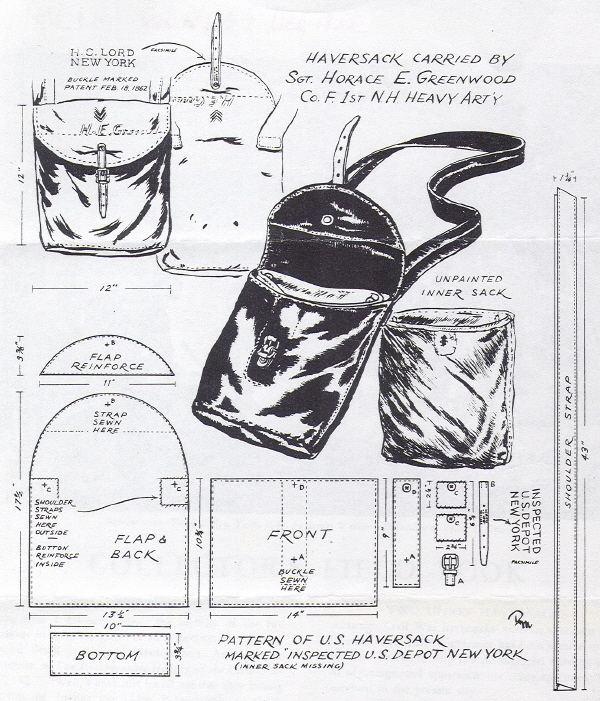
Ah the haversack, the Man-Bag of soldiers from the Revolutionary War to World War I. During the Civil War, it was the place solider's stashed personal gear. You can buy a Civil War Replica for about $15.00, or make one yourself following basic instructions.

This YouTube video also shows a simple haversack pattern, and was the spark that got me thinking about this topic in the first place. After watching the video, it occurred to me: couldn't I whip up something similar using a Tyvek Mailer?

Here's how I did just that:

Step 1: Assemble the supplies. I didn't end up using the pen. Feh, who needs to mark stuff when you can just wing it?

Step 2: Fold the envelope over. I created a nearly 5 inch flap. I'm not sure there's anything optimal about that.

Step 3: Slide the cardboard into the top of the envelope. Once in position, use a razor blade to cut one side of the envelope along the crease that you made in the fold from Step 2.

Step 4: Peel off the backing from the envelope's sticky flap and seal the envelope. There should now be one opening to the envelope: the opening you made in Step 3.

Bonus Project: Don't discard that backing strip from the envelope's flap. Instead, take a strip of Duct Tape and apply it to the glossy side. You've now got a short strip of duct tape that can be folded up and put in your wallet (or your brand new haversack). The cool part: because the glue from the Duct Tape and the backing strip are designed to play nice together, you can quickly deploy the Duct Tape with minimal effort. Try it, it's super effective. (I first learned of using tape backing to make Duct Tape easier to dispense from MeZillch's YouTube channel)

Step 5: Punch two holes near where the top of the envelope folds over.

Step 6: Thread a bit of cordage through the holes and you've got a completed haversack!

If everything went as planned, your little haversack has the same bonus featured mentioned in this video: the flap contains a pocket that will hold items when folded over. Watch the video to see what I mean. Pretty sweet, right?

So what can you do with your new creation? So much. Here's a few ideas: have your kids cover it with fun colored Duct Tape, and now they've created their own personalized bag. Use it on the trail for foraging: get it all nasty? No big deal, you can recycle it and make a new one. On the trail, you could empty it and use it as a sit pad; or fill it up with soft items and use it as a pillow. Or you could do what I did and make the world's lightest weight bike pannier:

I attached the haversack to my bike rack using a few zip ties. The result is small container, perfect for holding snacks and a few other essentials.

It won't win me any fashion contests, but it sure is functional.

Tuesday, April 05, 2016

Spike, Pam and Jeff - The friends you didn't know you could draw (but trust me, you can)

Grab a pen, a few sheets of paper and cue up this TED Talk. The presenter takes you through some cartoon drawings which require just a few strokes of the pen. It's along the same lines as Ed Emberely, where you appreciate that just a few well positioned lines is all it takes to make an object or person come to life.

Give it a try:

Lately, I've been keeping my TODO list on index cards and rather than tossing them, I've been sketching on the back. Hardly great art, but it sure is fun:

Monday, April 04, 2016

Giving the Pi a little Dirt Time: A Raspberry Pi Powered Garden Cam

We're entering that magical time in the X-Garden where the first tiny hints of life appear. Here's itty bitty Zinnias making a first appearance:

This seems like the perfect opportunity to capture a hyperlapse. After mulling it over, I decided the simplest and most reliable method would be to weatherize my Raspberry Pi, plug it into an all-weather extension cord and a webcam and write a quick script to grab and push photos up to the cloud.

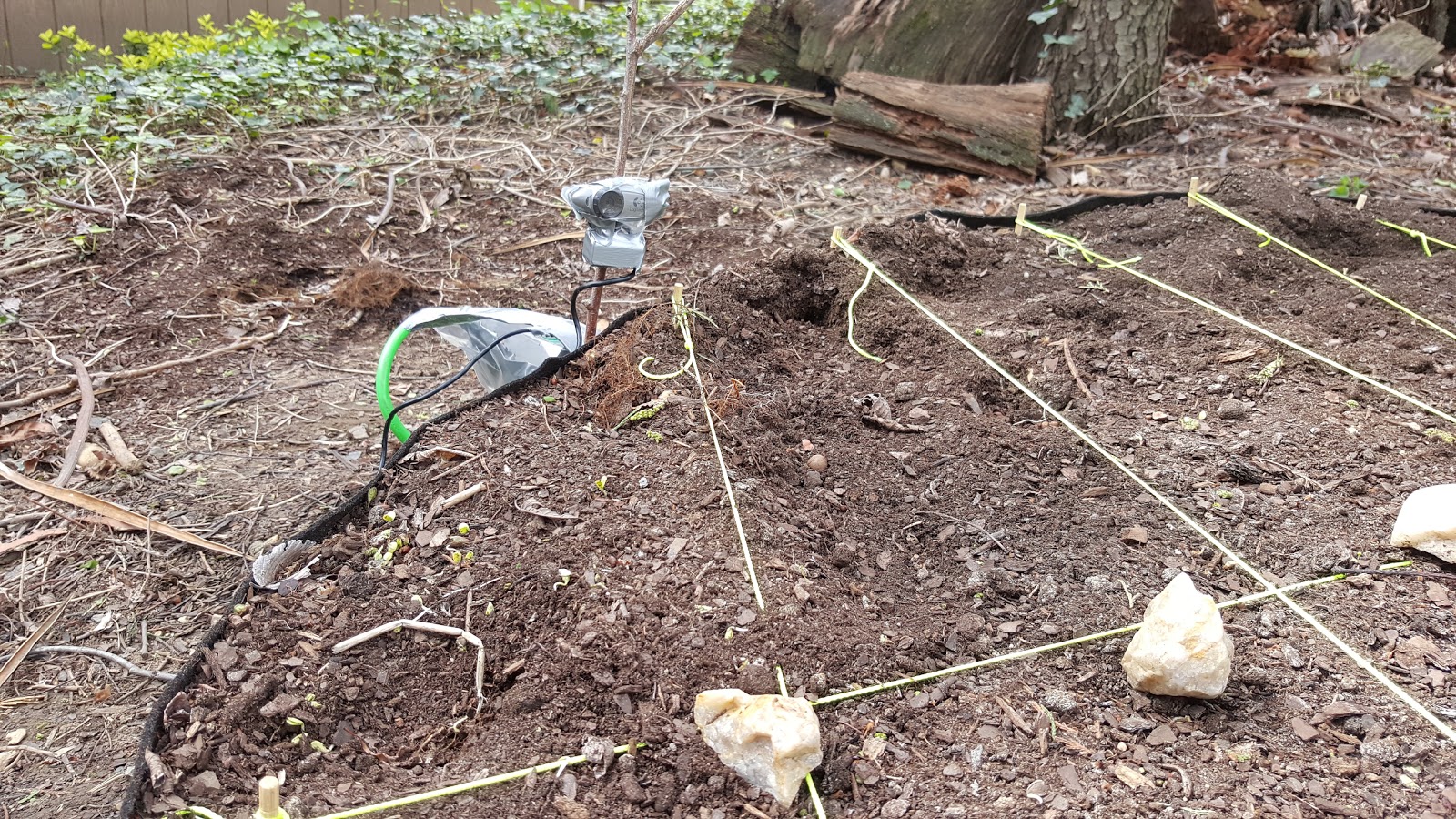
So that's what I did. Here's the Pi getting set for some dirt time:

Yes, that's a double-bagged Pi, with duct-tape providing the weather proof seal. Pretty silly looking, but I think it's just simple enough to work.

Scripting the Pi was truly the easy part. I installed fswebcam an s3cmd and whipped up this tiny shell script to snap and upload photos:

#!/bin/bash

file=/tmp/snap-`date +%Y%m%d.%H%M%S`.jpg
bucket=s3://files.benjisimon.com/garden/

fswebcam -S 120 --no-banner $file
s3cmd put $file $bucket
rm $file

I found the -S 120 was needed or fswebcam would grab a white image. I figure I'll grab lots of images and use ffmpeg to make the hyperlapse itself.

The weak link in all of this is the webcam I'm using. It's an ancient USB model which has horrendous quality. I've since purchased a new one on Amazon and will give that a try once it arrives.

The big question: after our first rain, will the Pi still be ticking? We shall see...

Friday, April 01, 2016

Quick and Hacky: Creating an Apache Slow Requests Log

As long as I'm on the topic of debugging web apps, here's a useful technique I don't believe I've blogged about before.

First off, add the following to your Apache configuration:

  CustomLog /var/logs/httpd/server.debug_log "%{X-Forwarded-For}i\t%t\t%U\t%{ms}T"

Now, restart the server and confirm it's giving you intelligent output:

$ tail -3 /var/logs/httpd/server.debug_log

zz.zzz.zzz.zzz  [01/Apr/2016:18:33:07 +0000]    /xxxxx/xxxxx/xxxxx  109
zz.zzz.z.zzz    [01/Apr/2016:18:33:07 +0000]    /xxxxx/xxxxx/xxxxx  142
zzz.zzz.zz.zzz  [01/Apr/2016:18:33:07 +0000]    /xxxxx/xxxxx/xxxxx  177

That's: IP address, timestamp, URI, duration in milliseconds.

Now, for the magic. Use awk to filter the stream to only requests that take longer the N millis:

$ tail -f /var/logs/httpd/server.debug_log   | \
   awk '{if($5 > 800) { print $0}}'

The above will show you all requests that take more than 800 milliseconds to complete.

Send this to a log file, and you've got the web version of a MySQL Slow Queries log.

Happy debugging!

Thursday, March 31, 2016

Let's Nosh

Mmm...crispy fries at Amterdam Falafelshop. Yum!

Recommended song: Do you want fries with that? by Tim McGraw.

Gotcha of the day: AWS EC2 Instance Periodically Gets Database Connection Timeout Errors

I recently migrated a client from a single server environment to a dynamic AWS environment. The migration went smoothly enough. But we ended up with an odd conundrum: at 3 minutes after the hour, various requests would fail with a database Connection Timeout error. It was like clockwork. 9:03. 10:03. 11:03. You get the idea. The problem struck for just a few seconds, but it absolutely impacted customers.

What the heck was going on?!

The Connection Timeout error (specifically, a MySQL Client error, 2002) seemed like a network issue. Was the network being restarted once an hour? Maybe we were getting a new IP from DHCP? Or perhaps there was some DNS action happening once an hour? To help determine this, I ran this recipe from the command line:

while sleep .5; \
  do date ; \
   echo | nc -vv  db.server.com 3306 ; \
   echo ; echo; echo; \
done

The above command uses netcat to establish a connection to the database. The output looks something like so:

Thu Mar 31 14:37:53 UTC 2016
Connection to db.server.com 3306 port [tcp/mysql] succeeded!
adfasfdafda^mysql_native_password

While much of that is gibberish - the -vv shows me that the connection was successful.

I kicked this off at 9:02pm. By 9:04pm, the usual alerts had come in saying that various DB connections had timed out. But my command line above, showed no such error.

So it wasn't a Linux networking issue. The network was stable throughout the event. Ugh.

After much more debugging, I whipped up this PHP script:

<?php
require_once('system/config.php');

$count = mysql_value("SELECT COUNT(*) FROM users");
echo date('c') . " | $count\n";
?>

The idea was to create a trivial PHP script (which of course, isn't really trivial because it's loading up our system config which pulls in a huge number of files) that runs a single, simple, database query.

I ran this bad boy in loop like so:

while sleep .5; \
  do php -f script.php ; done

10:03pm rolled around, and sure enough, the script hung and finally failed with a Connection Timeout. Now this was progress!

To truly figure out what I was missing, I turned to my good friend strace. I ran the above like so:

while sleep .5; \
  do strace -o /tmp/snapshot.out php -f script.php ; done

I waited for the command to hang and reviewed the file. The tail of the file was like so:

recvfrom(3, "\344\341\201\200\0\1\0\1\0\1\0\staging.db.server.com"..., 65536, 0, {sa_family=AF_INET, sin_port=htons(53), sin_addr=inet_addr("10.2.0.74")}, [16]) = 208
close(3)                                = 0
gettimeofday({1459436115, 155678}, NULL) = 0
socket(PF_INET, SOCK_STREAM, IPPROTO_IP) = 3
fcntl(3, F_GETFL)                       = 0x2 (flags O_RDWR)
fcntl(3, F_SETFL, O_RDWR|O_NONBLOCK)    = 0
connect(3, {sa_family=AF_INET, sin_port=htons(3306), sin_addr=inet_addr("58.28.1.102")}, 16) = -1 EINPROGRESS (Operation now in progress)

As is typical with strace most of the output was meaningless to me. But, it was clear what those last lines were showing me. First, it was stuck trying to connect to 58.28.1.102. Which was odd, because that wasn't our database's IP. And further more, it did a name lookup of: staging.db.server.com. Aha, so that's where the random IP address was coming from! It wasn't random, it was from our staging server.

In other words, at 3 minutes past the hour, something funky was happening that was causing our system configuration to fallback on communicating with our staging database. With this information in hand, the problem was trivial to debug. We had a process happening once an hour in cron, and when it ran, it refreshed a configuration file. While that configuration file was getting refreshed the system fell back to using the staging setup. It took swapping two lines of code to fix this monster of a problem.

So netcat, strace and traditional Unix skills won the day. However, I learned another incredibly valuable lesson. Whenever you report any sort of network error, you should also report the host and port you're trying to connect with. Had I included this in the database connection error, no Linux heroics would have been necessary. Lesson learned.

Tuesday, March 29, 2016

This May Sting a Bit: Embracing Your Life Calendar

And here's yet another TED Talk that's both entertaining and insightful: Tim Urban: Inside the mind of a master procrastinator. Here, take a few minutes and watch the talk:

I'm actually not much of a traditional procrastinator. My Computer Science degree, mainly filled with long running projects, played to my (then unknown) strength of living with, and chipping away at a problem. From timed math tests in 3rd grade to the SATs, I've never been much of a must-perform-this-minute kind of student. Just watching Tim discuss his academic career started to make my palms sweat. But his points are none the less well taken: we're all good at putting off the important for the fun and easy.

Tim's thesis is that where procrastination is truly a problem is when there's no due date to spur you into gear. Or as he scientifically explains: there's nothing to conjure up the Panic Monster to scare off your Instant Gratification Monkey. But Tim also provides us with a solution: the Life Calendar. Near the end of the talk he shows a grid of boxes which corresponds to one week for 90 years of an individual's life. Turns out, there is--if you pardon the pun-- a deadline for all our tasks, and it's going to happen before you think.

I saw this grid and immediately knew I needed to create a Life Calendar web app. So I did. You can access it here. The instructions are simple: enter in your birth day, hit refresh, wait a few seconds, and take it all in. Now cue the Panic Monster. You're welcome.

Here's my calendar. Almost half way filled in. Gulp.

You're welcome to view and modify the code for the calendar here. In truth it's little more than one of those beginner exercises they used to give us to learn about loops and working with dates.

Now if you excuse me, I've got a Panic Monster to wrestle with.

Monday, March 28, 2016

Garden Prep, 2016 - The Adventure Begins

Come over I said. We'll do some gardening, I said. What I meant was, help me clean up a winter's worth of debris from my yard and deck. This wasn't gardening, this was yard maintenance. And despite the fact that it would have been far more fun (and far less back-breaking) to tour some Civil War Battlefield, my parents came over and helped me get ready for Garden 2016, Ben Tries Again.

That's not to say that we didn't squeeze in a little planting while doing bed-preparation and such. My Mom planted some pretty pansy's and I seeded the X-Garden for yet another year of experimentation. My Dad dubbed the X-Garden the Evolution Garden, as we'll see which seeds are fittest to survive. We got a nice rain last night and today so hopefully everything's off to a reasonable start.

We still need the dreaded trip to Home Depot to pick up veggies and herbs to planted in the raised beds. But at least the beds are ready to go, so hopefully that process won't be too painful. I keep stressing to myself that this isn't a one-day activity. Baby steps is the way to go.

One of the lessons I learned from last year's X-Garden was that I needed to be far more careful about how I labeled the seeds. My casual attempts to keep track of what got planted where, failed almost immediately. Not this year! I neatly marked off the various zones and I've documented them below. Again, slowly but surely, I'm figuring this out.

And here's the seed layout:

(With my back to the house, facing our rear property line)

(Rear property line)
Zinnias
Wando PeasBorage
Heirloom OrachGround Cherry / Camellia Sinensis (Tea)
Heirloom PurslaneBlack Henbane
Heirloom Cabbage Danish BallheadCommon Milkweed
Bunching Onion Red WelshPeppermint
(Front property line)
(Rear property line)
Heirloom Cabbage Danish Ballhead Bunching Onion Red Welsh Wando Peas
(Front property line)