Tuesday, May 09, 2023

This Sucker Is Huge | Touring the Battleship Wisconsin

After a tasty, if not gut busting meal at Sushi King, we decided to stretch our legs and walk to the nearby waterfront. As we turned the corner, we found ourselves face to face with the USS Wisconsin. The Wisconsin, one of the largest battleships ever built, was a sight to see.

While I've been aboard a number of large Navy vessels, Michael and the kids have not. On impulse, we couldn't resist going aboard to see what this behemoth was all about.

The Wisconsin is attached to the Nauticus Museum. We zipped through the exhibits to get to the ship, stopping only to peer through the very cool WWII era periscope they have mounted for use.

Once on the ship, we toured the main deck and two decks above. We marveled at how massive everything was, from the 100lb chain links, to a deck that went on and on. The Wisconsin served in three distinct eras and conflicts. The ship was crafted for use in WWII, it then served in Korea and had a final tour of duty in the Gulf War. Imagine how the world changed from 1944 to 1991; the Battleship Wisconsin was like, no worries, I've still got this.

On an upper deck we came across the perfect encapsulation of these three time periods. Within a few yards of each other, you could operate an old school signal light, dial a rotary phone and marvel at a Tomahawk missile battery. Perhaps not surprisingly, the kids were most fascinated by the rotary phone. Having just finished a book on the Gulf War, it was impressive to be standing next to the hardware that kicked off that conflict.


After exploring the outside of the ship, we made our way inside and to the decks below. We saw the usual sights on ships like this: the impressive quarters for senior officers, the impossibly cramped quarters for the enlisted men (hello, 16 feet of storage space!), the various mess halls, a machine shop, surgical and dentist suites and more. I've seen all this before, but I continue to be amazed that we can create a floating city that operates nearly independently for months at a time.

Below deck, the sheer size of the vessel continued to impress. To my surprise, the Wisconsin is actually longer than the USS Intrepid, a friggin Aircraft Carrier. While we could only go two decks down into the ship, they did have a portal open to view below. Again, the ship just seemed to go on forever. For additional context, here's a photo of the Wisconsin next to the USS Antietam, a WWII aircraft carrier. This beast is *huge*.

Perhaps the most interesting part of the ship, however, was a seemingly random room we stepped into below deck. As we tried to figure out what we were looking at, I saw a plaque on a chunky dial and knob filled machine that read: Star Shell Computer. Hmmm, I thought, the Star Shell Computer company, I'll have to look them up and see what they're all about. A moment later, I realized I was parsing that text wrong: this wasn't the name of a company, I was staring at the "computer" used to launch the type of ordinance used to light up the battlefield, aka a star shell.

Eventually we figured out that we were in a gun plotting room and were surrounded by the computers used to aim and fire the huge guns on deck. These computers are unlike any we interact with today: they appear to be purely mechanical. Instead of electronics and software, these devices compute by use of gears and cams.

To find a mechanical computer on a WWII era vessel makes a lot of sense; in 1944 it would have been cutting edge tech. Heck, in the 1940's, the term 'computer' could easily refer to a person's job title. What's mind blowing is that according to this video, mechanical firing computers had a life well past the 40's. There's no reason to believe that sailors of the 1990's used any other technology to align and fire the guns aboard the Wisconsin. This may be the ultimate example of the adage if ain't broke, don't fix it.

At 4:45pm, the ship intercom came to life and informed us that the museum was closing in 15 minutes. We'd have to stop exploring, and make our way through the maze of corridors back to the surface.

What a treat it was to tour the USS Wisconsin and to share the experience with those who've never been aboard such a monstrosity. I can't recommend this highly enough.


Monday, May 08, 2023

Nachas in Norfolk

A huge Mazel Tov to B. for her graduation from ODU this past weekend. It was delightful to get to visit the ODU campus and see her big day.

We arrived to the Hampton Roads area on Friday evening and did a bit of walking around the campus. My first question: what's the monorail-like track promimently running through campus? B. explained that that it was the failed remnants of an engineering project:

Following the 2001 Fourth of July holiday, American Maglev Technology, Inc. (AMT) arrived on ODU’s campus to begin building a one kilometer elevated track, a research project that would cost $14 million dollars. This track was designed to support a small passenger car that would “levitate” on magnets, providing a smooth ride across campus. Twenty-one years later, the abandoned track has become a Stonehenge-like monument used as a landmark for directions, but still has yet to ferry a passenger.

That's a bold move ODU, leaving an engineering oops in plain sight for 20 years. Perhaps it's an important, cautionary tale for students?

After touring the campus, we had a delightful dinner at Guad's Mexican Restaurant and peppered B. with questions about campus life and her next steps. As we walked to our car from the restaurant we saw evidence of just how much of a Navy town this area is. We came across these large guns, no doubt rescued from the deck of a decaying ship and stashed in the corner of a parking lot:

What's surprising, is I can find zero mention online of the significance of these guns. There's no plaque or hint as to what's up with them. I found a property listing for the building, which includes pictures of the guns in the parking lot, yet, it is silent on whether the new owner inherits them or not. I do know, however, that the chandeliers within the building do not convey. I guess that's what happens when you're a civvy, you think that massive guns parked behind a random building is unusual.

Saturday morning, we joined B.'s family for the graduation ceremony. It was pretty much perfect weather, and our seats in the upper deck, close to the speakers turned out to be perfect. We had a great view of B. accepting her diploma.

The ceremony was run with surprising efficiency. It started a few minutes early(!), the grads filed in, the National Anthem was sung, and the commencement speaker was introduced. This year's speaker was Governor Youngkin. In Arlington, this would have been a controversial choice, but I'm guessing in the rest of Virginia he was a solid get. For his part, he gave a high quality, classic speech to the graduates. He steered clear of anything controversial, and about the only thing you could quibble with was that the speech was almost too polished.

A few students silently stood up and turned their back to Youngkin during his speech, as a form of protest. There were also some boos at one point, but they were covered up with cheers and any sounds from the crowd quickly faded.

After the speech, the degrees were confirmed and then each graduate had their name read and got a moment on the stage. 

After the ceremony, we made our way to the fountain and Lion and took more pictures and then it was off to Sushi King for all you can eat Sushi to continue the celebration.

What a day of kvelling and nachas!

Friday, May 05, 2023

Healthy, Easy and Very Very Dry - The Lazy Man's Salmon Jerky

Life before refrigeration was, to say the least, tricky. From households enduring barren winters, to sailors on lengthy voyages, to quartermasters trying to outfit an army; the challenge of turning fast-spoiling food into shelf-stable fuel has been a common challenge. What was this like?

While I can watch plenty of YouTube videos on the topic, the living history community has convinced me it's far more meaningful to roll up my sleeves and strive to experience history first hand.

To fully appreciate this food dilemma, I could hit the local fishing hole, catch some fish and then do some field expedient smoking of the fillets. While that sounds like fun, I don't have the time to go this big. But what about a simpler experiment? Why not take a page out of our Native American neighbor's playbook and try drying the fish I have in my freezer? Sure, it's cheating to use store bought fish and an oven instead of freshly caught fish and a fire; but I'd still get a sense of what it was like to turn a quick to spoil food into one that endures.

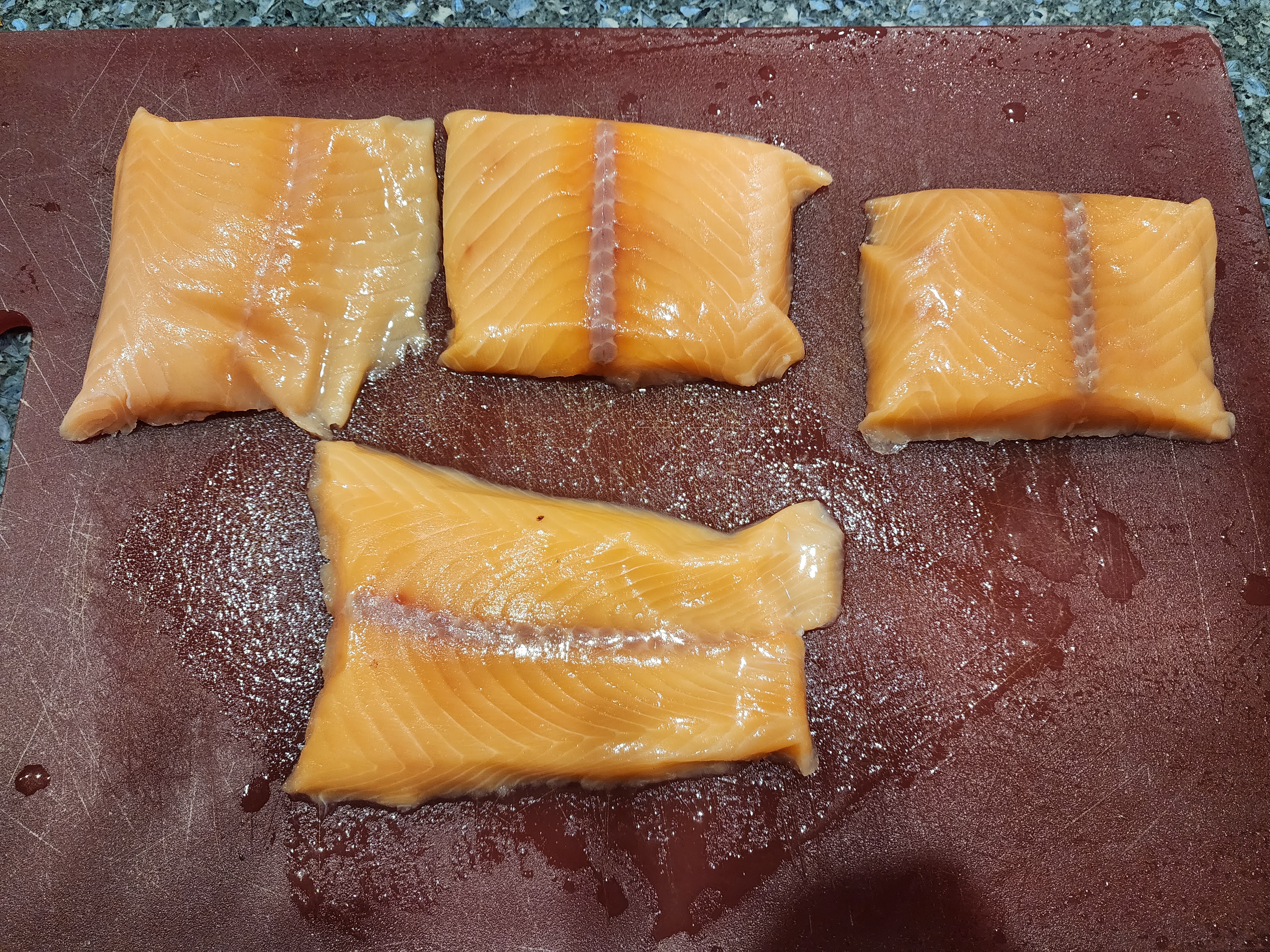
So that's what I did. I started by defrosting the frozen salmon that we had on hand. I then sliced the fillets into strips, and for good measure, sprinkled some salt on top. Finally, I put the trays of fish in the oven and hit the 'Dehydrate' button. I started with 680 grams or so of fine looking salmon:

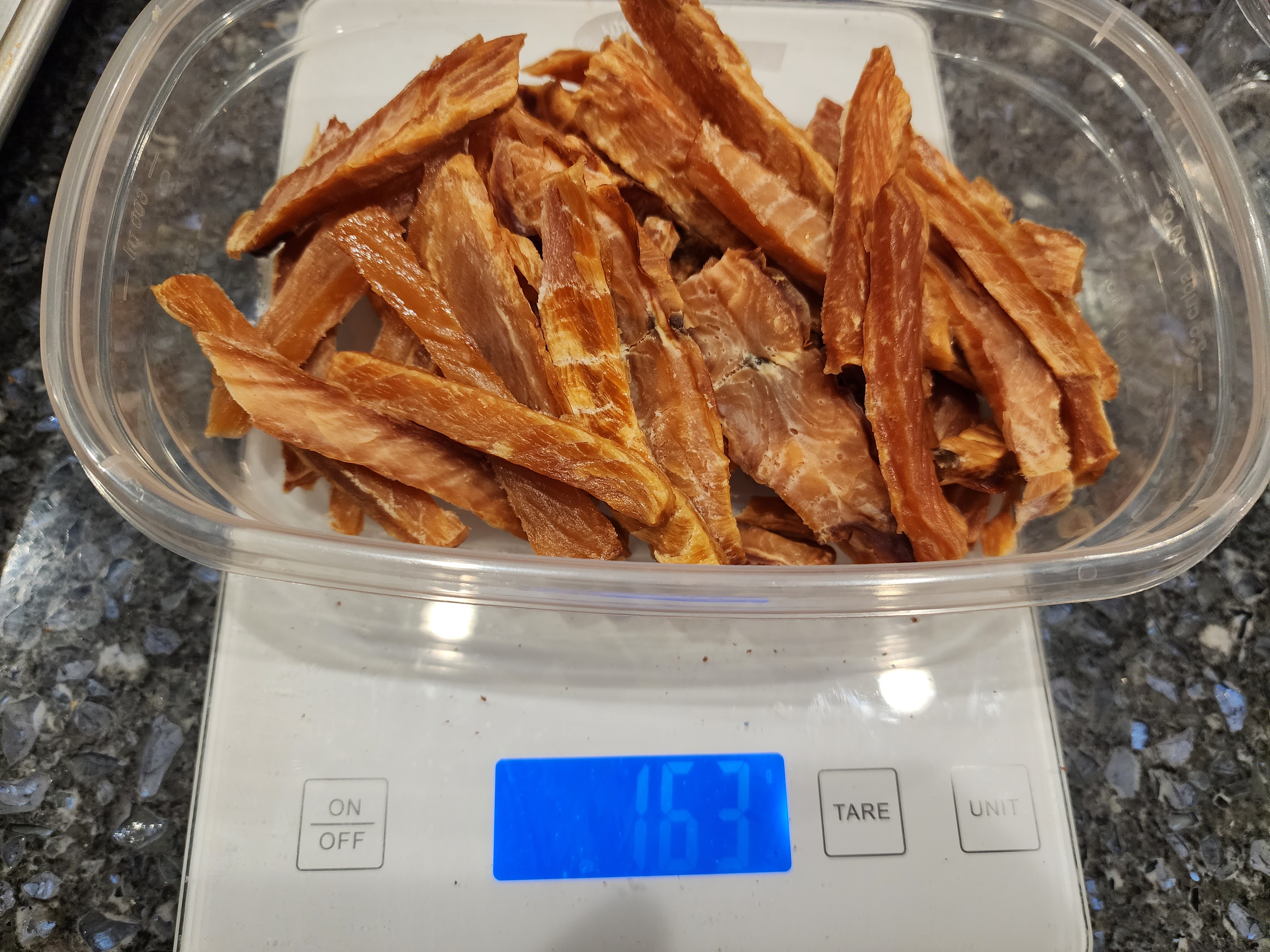
After about 24 hours, I had a very shriveled 163 grams of "fish."

To my surprise, the dried salmon actually tasted good. When I experimented with making beef jerky, the result was mediocre at best, and I haven't bothered to try again. In contrast, I'm already thinking about the next batch of dried salmon I can cook up.

Truthfully, I was expecting the drying process to yield something barely edible. I figured I'd walk away with a fresh appreciation for how tough folks were back in the day, and how thankful I am for our modern amenities. Instead, I feel like I've stumbled on a new backpacking super-food. The dried fish is lightweight, protein dense, mess-free, stoveless, shelf-stable, kosher, parve, easy to procure, effortless to prepare, historically motivated and compared to store bought jerky, an absolute bargain.

How has this not been part of my backpacking and hiking menu since forever?

The main thing I would do differently next time is to play around with reducing the drying time. I assume that the dryer the fish is, the longer it will endure without refrigeration. When I ran the experiment above, I sampled the batch after 4 and 6 hours, and it definitely tastes better with more moisture left in the fish. So, assuming that I'm not planning a lengthy sea voyage or extended military campaign, I may try to get away with less drying time in exchange for a somewhat better taste. Or, maybe not. We'll see.

In theory, if I'm feeling really luxurious, I may try marinading the fish and making myself a proper batch of salmon jerky. But it's hard to argue with the simplicity and elegance of slice, dehydrate and done.

Wednesday, May 03, 2023

Streamlining the Google Takeout Process

A few days ago I found myself in the lobby of my car repair shop waiting for our vehicle's inspection to be completed. The nightly news was blaring from a TV, and there was a woman in tears on the screen. She had either missed or ignored Shutterfly's recent storage policy change, that read in part:

In January 2023, Shutterfly’s photo storage policy was updated, offering unlimited photo storage to active customers who make a purchase every 18 months. As part of the policy update, any photos stored in a customer’s inactive account would be permanently removed from our servers.

She was devastated because she had lost decades worth of photos because she had neglected to keep her account active.

As sympathetic as was I was to the woman on TV, I have to admit I had a moment of mental superiority. I couldn't help but think: Hah! That's what you get when you trust an unreliable platform to store your data. I store my images safely in Google Photos, so I'm good.

It took about 30 seconds for me to see the flaw in my thinking. The woman's sin wasn't merely relying on an untrusted storage partner; it was that she opted to store her data in a single location. From that perspective, I was just as guilty as her. While it's unlikely that Google Photos will disappear any time soon, it's still not ideal to have precious data housed without a backup.

Backing up a Lifetime of Photos

This got me thinking: how could I export the 25,000 or so pics I have in Google Photos to Amazon's S3 platform? S3 is relatively cheap and, most importantly, isolated from Google's hardware and policies.

Google solves a big part of problem with their Takeout Service. Takeout effortlessly bundles your personal data stored on Google into .zip or .tgz files that you can access with ease.

Exporting my Photo library to a series of .tgz files that are accessible in Google Drive took just a few clicks.

Once I had the 58(!) export files, each one weighing in at 50 gig, how was I supposed to pull them off of Google and push them to S3?

The solution I arrived at is found in takeoutassist. This shell script leverages the command line tools gdrive and aws, to pull files from Drive and push them to S3.

The script assumes that any top level folder in Google Drive named Takeout was generated by Google Takeout. One at a time, it downloads a file from this directory, uploads it to an S3 bucket, verifies the upload was successful and then deletes the file from Google Drive.

The process looks like this and is slow as molasses:

$ takeoutassist -a archive -p benjisimon@gmail.com -t 2023-05-02
Downloading takeout-20230502T052704Z-055.tgz
Successfully downloaded takeout-20230502T052704Z-055.tgz
move: .takeoutassist/holding/takeout-20230502T052704Z-055.tgz to s3://archive-benjisimon-com/takeout/benjisimon_gmail.com/2023-05-02/takeout-20230502T052704Z-055.tgz
Deleted 'takeout-20230502T052704Z-055.tgz'
Downloading takeout-20230502T052704Z-057.tgz
...

Thankfully the process is automatic, so I can kick it off and forget about it.

In another few months I'll put in another Takeout request to grab a fresh backup. At that point, I'll add a feature to takeoutassist to remove the old Takeout data from S3 to avoid paying for multiple copies of my backed up data.

I feel for the woman on the news, but at least I could put her pain to use as motivation to avoid her fate.

Friday, April 28, 2023

Review: Stormjammers: The Extraordinary Story of Electronic Warfare Operations in the Gulf War

Earlier this year, I read a terrific book about World War II Spy, Virginia Hall. Hall operated in occupied France. During Hall's service, one piece of tech that was a game changer for both spy and occupier alike, was the portable radio transceiver.

The Type 3 MK II, known as the B2, is one example of such a transceiver. The unit was packaged as a luggable suitcase and weighed in at a hefty 32 ¾ pounds. For the allies, having a radio operated in-country meant intelligence could be delivered in near real time. But this arrangement came with staggering risks. While transmitting, French and German authorities could relatively easily track the radio transmitter. Every moment radio operators were sending messages, they was also loudly announcing their position to an enemy intent on catching and cruelly punishing them.

Radio messages could also be jammed, intercepted and spoofed. Making use of wirelesses capabilities was a high stakes game of cat and mouse, that resulted in both extraordinary successes and cataclysmic failures.

So what does all this have to do with Stormjammers, a book about a soldier's tour of duty in the first Gulf War?

Stormjammers may be set 50 years and 3000 miles from Virginia Hall's story, but again, the use of radio is center stage. This time, we follow the story of Robert Stanek, who served on an EC-130, an aircraft that is optimized for Electronic Countermeasures.

Stanek's mission was to intercept and jam radio communications. This helped make the battlefield significantly safer for other friendly units operating in the area, because the enemy's communications and targeting systems often depended on radio. In short, when Stanek's team was operating, the enemy was blind. Once again we find ourselves in the high stakes cat and mouse game of wireless communication and the action is no less exciting than it was in Hall's story.

One can imagine that thrill and risk that comes with being a fighter pilot or a bomber. But what about the team that has to spend hours slowly circling over a barrage of anti-aircraft fire, with no offensive weapons and little more than 'evasive maneuvers' to protect themselves? Stanek brings us into this world, from the bordem and fatigue to the white nuckle, brace for impact moments. His writing does a quality job of capturing the full spectrum of emotion and action.

The first Gulf War, including Operation Desert Storm took place when I was a high school student. It was featured nightly on the news. These factors helped make it my "first war" growing up and some parts I remember vividly. For example, the super low quality, green-tinted video clips taken by reporters on the ground and transmitted via cutting edge satellite phone technology. We also got to witness the magic of Patriot Missile batteries taking out scud missiles mid flight

Other parts of the war, came back to me upon reading Stanek's text, including Iraq's frequent missile attacks against Israel. Israel wasn't a participant in Desert Storm, but Iraq's strategy was clear: anger the Israeli's to the point where they would enter the war, at which point the Arab countries participating in Desert Storm would have no choice but to stop their assault on Baghdad. The risk of being aligned with Israel was just too great to even consider. Thankfully, Israel never took the bait.

Stanek's mission was powered, at the time, but what must have been considered absolutely cutting edge technology. And yet, having lived through that era, I can only imagine the kind of hardware Stanek had to make do with. We were fortunate to be a computer forward family. We had a home computer, and my parents bought me a laptop to help me conquer my dyslexia. Both machines were state of the art, and here's what they looked like:


That's a Compaq Portable and a NEC PC-8500. We had a later version of the Compaq than what's shown above, but the tiny monitor and luggable form-factor were still part of the deal. The photo of the PC-8500 is the actual device I owned. Boy does cracking it open bring up some feelings. Both were amazing devices for their times, but their underyling hardware would have made for a horrendous choice while operating in a war zone. It was one thing for us to reboot because Where in the World is Carmen Sandiago? hung, it's an alogether different scenario when your dinosaur of a computer chooses not to boot and dozens of aircraft and thousands of pounds of ordance depend on you getting the device to cooperate.

Accounts of wars from a regular soldier's perspective will always make for fascinating insights. In many ways, Stanek's book fits into this genre. He may have been operating thousands of feet above the battlefield staring at a computer screen, yet many of the concerns, frustrations and victories he writes about would be familiar to a private in the Civil War. Lousy food, inadequate quarters, missing loved ones, processing the horrors of war and dealing with the irrational machine that is the US military are just a few of the topics that Stanek writes about and would be familiar to any soldier in any conflict.

Here's one final memory I have of the Gulf War. When it started, I recall my social studies teacher, Mr. McLaughlin was not at all pleased. To our young minds, this seemed like 'war done right.' There was a clear mission, a diverse coalition of participants and we had the moral high ground. Yet, Mr. McLaughlin promised us that the start of the Gulf War was a sad day and that were starting a conflict that would take years to extract ourselves from. Now I appreciate he was speaking from experience with Vietnam, a war at the time that was as real to me as say the Battle of Hoth. Mr. McLaughlin was, of course, wrong. Operation Desert Storm lasted for 42 days. It would take a mere dozen years, however, for his fears to blossom into reality. In 2003, we invaded Iraq and started an 8 year war that would match Mr. McLaughlin's predictions to a tee.

Tuesday, April 25, 2023

From Three Answers to Four Sons

For as long a I can remember, Seder night has always includes at least a few minutes spent trying to puzzle out fresh meaning from the description of the Four Sons.  What makes the Wicked Son's question wicked? Why can the Wise Son say 'to you' but the Wicked Son gets scolded for this? Why is the answer to the Wicked Son given to the Son Who Can't Even Ask? Is calling the child the Simple Son a polite way of saying he's dumb? What does it mean to be Simple? And on, and on.

This year, I took a step back. How did we even get here?

Where It All Began

If you were casually reading through the Torah, you would notice three times when a parent is instructed to teach their child about the Exodus. Here are the sources:

First in Exodus, chapter 12 verses 26 and 27:

And when your children ask you, ‘What do you mean by this rite?’ you shall say,

‘It is the passover sacrifice to יהוה, who passed over the houses of the Israelites in Egypt when smiting the Egyptians, but saved our houses.’

Second, a chapter later, in Exodus 13, verse 8:

And you shall explain to your child on that day, ‘It is because of what יהוה did for me when I went free from Egypt.’

And finally, in Deuteronomy, chapter 6, verses 20-25. Note, the child in this case isn't asking about the Exodus or Passover. Instead, he's asking about the rules transmitted by Moses in general. The response notably includes the Exodus.

When, in time to come, your children ask you, “What mean the decrees, laws, and rules that our God יהוה has enjoined upon you?” you shall say to your children,

“We were slaves to Pharaoh in Egypt and יהוה freed us from Egypt with a mighty hand. יהוה wrought before our eyes marvelous and destructive signs and portents in Egypt, against Pharaoh and all his household; and us [God] freed from there, in order to take us and give us the land promised on oath to our fathers. Then יהוה commanded us to observe all these laws, to revere our God יהוה, for our lasting good and for our survival, as is now the case. It will be therefore to our merit before our God יהוה to observe faithfully this whole Instruction, as [God] has commanded us.”

From Three Answers to Four Sons

These verses are obviously significant and offer a number of surface insights. One that jumped out to me was the need for parents to not only teach their children, but to provide meaningful answers to them. Because I said so and tradition! aren't going to cut it. 

The Rabbis of the Talmudic era, including Rabbi Chiyya (c.200 - c.220 CE), captured two brilliant innovations involving the quotes above. First, they put these questions into the mouths of different types of children and second, they added a Fourth Child: One Who Can't Even Ask a Question. Rabbi Chiyya's version of the Four Sons is recorded in the Jerusalem Talmud, Peschaim 10:4:

HALAKHAH: Rebbi Ḥiyya stated “The Torah spoke about Four Children, a wise child, a wicked child, a stupid child, and a child who does not know how to ask. What does the wise child say? What are the testimonials, the ordinances, and the laws, that the Eternal, our God, commanded us? Also you shall tell him, with a strong hand did the Eternal lead us out of Egypt, the house of slaves. What does the wicked son say? What does this service mean to you? What is this exertion which you impose on us every (moment) [year]? Since he excluded himself from the community, also you shall tell him, because of this did the Eternal do for me when I left Egypt. For me, He did it, for that man He did not do it. If that man had been in Egypt, he would not have been worthy ever to be redeemed. What does the stupid child say? What is this? Tell him the rules of Passover, that one may not follow the Pesaḥἐπὶ κῶμον. What means ἐπὶ κῶμον? That one not leave one company and join another company. With the child who does not know how to ask, you have to begin and initiate with him.” Rebbi Yose said, that is what the Mishnah says, “if the son does not know how to ask, his father instructs him.”

While our modern Haggadah's version of the Four Sons differs from this text, the essence remains the same.

The Four Sons: Old School vs. Today

One difference that will jump out to those familiar with the modern text is the identification of a 'Stupid child.' This isn't merely a less politically correct translation of the Four Sons than we are used to; Rabbi Chiyya uses a different Hebrew word to describe the third child (טִיפֵּשׁ vs תָּם). There are other striking differences as well. The Wise Son is offered the answer that we now give the Simple Son. The Third Son now receives an obscure (to us) answer about the procedure of eating the Passover Sacrifice.

While these differences are interesting and worth probing (next year, people!), I'm more impressed by how similar the ancient text is to what we read yearly on Passover.

The Four Sons as an Innovation

For nearly 2000 years, if not longer, we've been putting these quotes into the mouths of different children. Inspecting the quotes reveal that they are relatively neutral. If anything, the answer given in the last question, posed in Deuteronomy, could easily come from a child lacking sophistication. The child seems to be confused by all the rules and regulations, and the response isn't to get into the weeds, which is what the modern Haggadah suggests. Instead, the Torah provides an elegant, big picture response. Rabbi Chiyya's text leans into this, and suggests that this is is exactly how the back and forth with the Wise Son should go. Our version of the Four Sons uses the same question as Rabbi Chiyya, but offers a different answer than what is provided in the Torah. Perhaps the authors of Haggadah were picking up on the same 'simple answer vibes' that I was when reading Deuteronomy's dialog?

It's also revealing that the answer given in the Haggadah to the Child Who Doesn't Yet Have the Ability to Ask, is given the same answer as the as the Wicked Child.  This choice to reuse an answer seems to further suggest that the fourth child was an important addition to the Rabbis. Even without a unique proof text in the Torah, they thought he was worth including.

So we've turned three general exchanges about learning into four different personalities asking questions; and I love it. I love it because it adds a dimension about teaching that goes unsaid in the Torah, but is powerful. I see the Four Sons as modeling the requirement that parents must meet their children where they are. By making the Four Sons such a central part of the Haggadah, the Rabbis have invented a sort of Talmudic no child left behind policy.  Well played Rabbi Chiyya and peers, well played.

Friday, April 21, 2023

Encountering NY's Finest

Does heaven exist? It's a question theologians have grappled with for millennia.

Turns out, it does, and it's located in Nanuet, NY.

Last Sunday, at 6:30am, we walked into Rockland Bakery and we were greeted by an amazing display of mouth watering desserts.  I noticed a letter hanging above the display cases that announced the establishment was under Kosher supervision. Sweet!

After making some difficult decisions (apparently, "I'll take one of everything!" didn't seem like a reasonable request), we finally approached the cashier and asked for our selections to be boxed up. While we were at it, we asked if they had any bagels. It was a bagel recommendation from one of Shira's coworkers, after all, that was our motivation for tracking down the bakery in the first place. For bread, the lady behind the counter explained, you'll need to walk through that corridor, grab some gloves, and pass through a pair of double-doors to make your selection. Not quite sure what to expect, we followed the nice lady's instructions.

And just like that, we were in heaven. Before us was a smorgasbord of fresh bread in every shape and size. The area hummed with action, as piping hot bread ran along various conveyer belts. One machine pooped out hot bagels, while another produced an infinite stream of small loaves. In awe, we clumsily filled a couple of brown paper bags with bread products of all types.

Back at the checkout counter, and reunited with our pastries, the cashier rung us up. To our surprise, the prices were impressively low. 

Even though it was only 7am, I immediately downed my whip cream eclair. Shira showed more restraint, and waited till the airport until she tried one of the black and white cookies she had bought. There were outstanding. Probably the freshest and tastiest she's ever had, and this is a woman who knows a thing or two about black and white cookies. And the jelly donut. Oh, the jelly donut. I was going to try just a bit of it before our flight, but ended up snarfing the whole thing down.

Just typing this blog post up again has me thinking about defrosting some of the goodies we froze from the bakery. It was all that good.

So how does one get to heaven? Easy, just ask Google Maps.

Tuesday, April 18, 2023

Hiking Nyack Beach to Hook Mountain and Back

Last weekend we found ourselves in White Plains, NY celebrating a friend's simcha (Mazel Tav S.!). We had a few hours free and a gorgeous weather forecast, so we decided to do a hike in the area. After a bit of research we opted to hike the Nyack Beach - Hook Mountain loop.

The hike started off pleasantly enough as you ascend to Hook Mountain. We found ourselves with views of the road and nearby houses, so while it was a nice trail, it did give off suburbia vibes. By the time we summited Hook Mountain, however, we felt fully remote and were treated to some amazing views of the Hudson River and surrounding area. I tried to capture the scene with some panoramic photos, but none of them did the views justice.

One unexpected find at the top of Hook Mountain was a patch of cacti. I don't recall seeing cacti in the wild on any hikes in the North East. That's NY for you, always full of surprises.

From Hook Mountain we walked North along the ridge overlooking the river and were treated to additional breathtaking overlooks. At one point we turned more and found ourselves in forested canopy. One treat in this section was a number of old brick structures that I was able to grab photos of. I wondered about their history: were they relatively recent homes, or did they have storied history?

Before we reached the Northern end of the hike and descended, the route detoured to give us one last view of the river and surrounding area. It was all gorgeous. Shira commented that the industrial looking buildings across the river were in fact Sing Sing prison. Some telephoto shots revealed guard towers and fencing.

The descent from the ridge was straightforward, and before we knew it, we found ourselves on a wide and well maintained trail along the edge of the Hudson River. I did a bit of beach combing along a short tract of sand. One unexpected discovery was a brick that had washed ashore with a prominent "& S" stamped on it. Of course someone has cataloged historic brick companies in the area and it looks like I stumbled on a Denton Fowloer & Sons specimen. As the site explains:

In 1883, Denton Fowler & Sons owned a brickyard in Haverstraw and produced 9,300,000 brick with 5 machines, employing 80 men. They also owned the land.(History of Rockland County, J.B. Beers & Co., 1884)

According to Google Maps, Haverstsraw, NY is just up the river from our hike, so that checks out.  I'm still not sure which is more impressive: that I stumbled on a brick from the 1800's; or that I was able to effortlessly identify it online.

The walk on the river trail was easy enough and before we know it, we were at our car.

Overall, I was very impressed with this hike. The views, historic structures and solitude on the trail made it an absolute winner. If you find yourself in the area, it's worth doing.